

This guide explains every category of AI tool a dealership can buy in 2026, who the real players are in each one, what they actually do, and how to choose.
What is an AI tool for a car dealership?
An AI tool for a car dealership is software that uses artificial intelligence to perform, assist with, or automate dealership tasks that traditionally require human time and attention. Depending on the tool, that might mean answering a customer’s call, responding to a text, following up with a lead, qualifying a prospect, editing vehicle photos, writing listings, creating marketing content, or analyzing dealership data to identify opportunities and problems.
That is a wide definition, so it helps to split dealership AI into three kinds. Almost every product on the market is one of these three:
| Type of AI | What it does | Dealership example |
|---|---|---|
| Supportive AI | Helps a person work faster, but a person still does the work. | AI writes a follow-up email for your salesperson to review and send. |
| Agentic (autonomous) AI | Completes a task on its own, end to end, and only involves a person when needed. | An AI voice agent answers an after-hours call, books the service appointment, and texts a confirmation. |
| Generative AI | Creates something new: text, images, or video. | AI writes vehicle descriptions or turns lot photos into a 360-degree spin. |
The distinction matters commercially. Supportive AI saves your team minutes. Agentic AI covers hours you currently do not cover at all — nights, weekends, lunch rushes, and every moment your phones are already ringing. That is where most of the measurable money is.

Why Are Car Dealerships Using AI?
Because AI now buys coverage a dealership cannot staff. It answers the call at 9pm, replies to the lead in seconds, and books the service appointment on a Sunday. Dealers have moved quickly on it. According to the Cox Automotive AI in Auto Retail Tracker published in August 2026, 82% of dealers use AI today and 69% expect it to drive sales and revenue growth.
The number worth studying is the third one. Only 22% of dealers using AI say they are seeing that growth yet, and about one in three either are not measuring AI’s impact or have no clarity on it.
Read that as a targeting problem, not a verdict on AI. Most dealerships bought a tool without deciding what it was supposed to fix, so they cannot tell whether it worked. The dealers who do see the return are almost always the ones who pointed a tool at one measurable number and then watched that number.
Two more findings from the same study back that up. Dealers working with an outside AI partner were considerably more likely to report sales growth than those going it alone — 36% versus 21%. And the uses dealers reported most were the concrete ones: automating routine or complex tasks (40%), coordinating customer follow-up (40%), and generating content and creative (38%). The rest of this guide is built to keep you on that side of the line: pick the leak, pick the tool, measure one number.
The 10 categories of dealership AI tools
Most confusion in this market comes from treating “dealership AI” as one product. It is more. Here is the whole map on one page.
| Category | Description | Example AI Tool |
|---|---|---|
| Conversational AI (AI Sales Agent) | engage shoppers, answer questions, collect qualification information, follow up and move conversations toward appointments. | Drivee AI, Impel, Gubagoo, Conversica, Matador AI. |
| AI voice agents (phone and BDC) | Voice AI can answer inbound calls and, depending on the product, support outbound calls, scheduling, lead qualification and call routing. | Drivee AI, STELLA AI, Numa, Matador AI. |
| Website AI Assistant (Chat Widget) | Website AI can answer questions and capture leads. More advanced tools can use inventory information, recommend vehicles and book appointments. | Drivee AI, Impel |
| AI Lead Follow-Up Tools | These tools automate follow-up through channels such as SMS, email, and voice. More advanced tools analyze lead’s behaviour and tailor follow up pattern and sequence | Drivee AI, Conversica, Matador AI |
| AI marketing automation and advertising | Marketing AI can help dealerships segment audiences, personalize campaigns, activate customer data, and automate vehicle listings across advertising platforms and marketplaces. | Drivee AI, Fullpath, Lotlinx |
| AI photography, 360 spins and merchandising | AI-powered 360° photography tools can transform standard vehicle photos into studio-quality, interactive 3D models and create immersive video tours with AI-generated narration. | Drivee AI, Spyne, CarCutter, Impel. |
| AI inventory, pricing and valuation | AI inventory assistants help dealerships decide which vehicles to stock, how to price them, and which inventory to prioritize for faster sales. | Drivee AI, Lotlinx. |
Every capability claim comes from the vendor’s own website, checked in September 2026.
The best AI tools for car dealerships in 2026, by category
Conversational AI
This is the category that pays for itself fastest, because it covers the two leaks above: unanswered phones and slow lead response. These tools answer a customer in seconds, at 9pm on a Sunday, in whatever channel the customer used.
The important question is not “does it have AI?” but “which channels does it actually cover, and can it finish the job?” Some of the best-known names in this category do not handle phone calls at all.
| Tool | Built for | Channels published | Phone calls |
|---|---|---|---|
| Drivee AI | Auto retail only | Phone, SMS, web chat, email, Messenger | Inbound and outbound; 100+ languages |
| Impel | Auto retail only | Email, SMS, web chat, WhatsApp | Missed inbound service calls, with SMS follow-up |
| Podium (Jerry) | Local business, incl. auto | Phone, SMS, email, web chat | Inbound and outbound |
| Gubagoo | Auto retail only | Web chat, SMS, Messenger, WhatsApp, Apple Messages | Not published |
| Numa | Auto retail, service-led | Phone, SMS, Web Chat | Inbound and outbound |
| STELLA Automotive AI | Auto retail only | Phone, SMS, Web Chat | Inbound and outbound |
| Matador AI | Auto retail only | SMS, phone, chat, email, Instagram, Marketplace | Inbound only, per its own site |
| Toma | Auto retail only | Phone, SMS | Inbound; outbound not published |
| Conversica | B2B, auto is one solution | Email, web chat, SMS | Not published |
Listen to this guide
Best AI Tools for Car Dealerships in 2026
Drivee AI vs Conversica: automotive depth against general-purpose maturity
Conversica is one of the longest-established names in AI follow-up, founded in 2007. It is worth comparing because the difference is instructive: Conversica is a broad business platform where automotive is one solution, while Drivee is built only for car dealerships.
| Drivee AI | Conversica | |
|---|---|---|
| Built only for auto retail | Yes | No — automotive is one industry solution |
| Web chat, SMS and email | Yes | Yes |
| Facebook Messenger | Yes | Not published |
| Phone calls handled by AI | Yes — dedicated AI voice agent, inbound and outbound | Not published |
| Languages | 100+ on the voice agent | Multilingual; number not published |
| Vehicle photography and video in the same platform | Yes — 360 spins and AI video tours | No |
| Named DMS and CRM integrations on site | Yes — 30+, including CDK Global, Tekion, PBS, VinSolutions, DealerSocket | No individual partners named |
Sources: drivee.ai and conversica.com, September 2026.
Drivee AI vs Matador AI
| Drivee AI | Matador AI | |
|---|---|---|
| Built only for auto retail | Yes | Yes |
| Web chat, SMS and email | Yes | Yes |
| Facebook Messenger | Yes | Yes |
| Phone calls handled by AI | Yes —inbound and outbound | Yes —inbound Only |
| Languages | 100+ on the voice agent | English & Spanish |
| Vehicle photography and video in the same platform | Yes — 360 spins and AI video tours | No |
| Named DMS and CRM integrations on site | Yes — 30+, including CDK Global, Tekion, PBS, VinSolutions, DealerSocket and more. | Yes — 30+, including Reynolds and Reynolds, CDK Drive, Dealertrack, PBS Systems and more. |
AI lead follow-up and lead scoring
Follow-up AI keeps working a lead long after your team has moved on. However, effective follow-up is not simply about sending more messages or extending the follow-up period. The AI needs to understand when to reach out, what to say, and how to engage each lead without sounding spammy, repetitive, or robotic.
More advanced follow-up tools analyze lead behavior and interactions to determine the right timing, messaging, and follow-up pattern for each customer. For example, Drivee AI analyzes lead behavior across conversations and website interactions, then follows up at the right time using proven engagement patterns and personalized messages designed to revive inactive leads and encourage them to move closer to a purchase.
Lead scoring AI, on the other hand, tells your team which leads to work first. These are different jobs and are often sold separately.
For follow-up, the established names are Conversica, Matador AI (which advertises a 180-day follow-up window), Impel, and Drivee AI. For scoring and prioritization, the capability usually sits inside the CRM: VinSolutions Predictive Insights, DealerSocket’s AI lead scoring, and Fullpath’s customer data platform all rank customers by their likelihood to buy.
VinSolutions reports that shoppers its system flags as ready to buy are nine times more likely to purchase within 30 days. That is a vendor figure, but the logic is sound: your team has time to work a fraction of your database properly, so the order matters.
AI CRM and customer data platforms
This is the most consequential and most expensive decision in the list, because the CRM is where everything else connects. It is also the category that changed most in 2026.
| Tool | Owner | AI published | Built-in CDP |
|---|---|---|---|
| VinSolutions Connect CRM | Cox Automotive | Predictive Insights; Virtual Contact Assistant | No — uses Cox shopper data |
| Fullpath | Cox Automotive (since June 2026) | Agentic CRM, labelled “Limited Release” | Yes — CDP is the core product |
| CDK CRM (formerly Elead) | CDK Global | AI Virtual Assistant; AI writing and summaries | Yes |
| DealerSocket | Solera | Conversational AI lead response; AI lead scoring (announced Feb 2026) | Not published |
| DriveCentric | Not published | Five named AI agents: Nurture, Prospect, Sales, Service-to-Sales, Performance | Not published |
| Salesforce Automotive Cloud | Salesforce | Agentforce agents for sales, service and finance | Yes, at top tiers only |
Sources: vendor websites and Cox Automotive, September 2026.
AI marketing automation and advertising
These tools decide who sees which vehicle, on which channel, at what moment — and keep your listings live and accurate without someone re-posting them by hand.
- Fullpath — a dealer customer data platform with advertising across search, social, display and programmatic, plus email and SMS activation. Reports 11 million data points ingested daily and holds ISO 27001 and ISO 42001 certification.
- DAS Technology (formerly Digital Air Strike) — a customer data and experience platform covering advertising, reputation and messaging; reports 9,300+ dealerships, retailers, partners and OEMs.
- Lotlinx — VIN-level advertising and inventory intelligence; reports 37% fewer days on the lot and $445 less in markdowns per VIN compared with market average.
- Drivee AI — automated advertising that publishes inventory across channels including Facebook Marketplace, Craigslist, and Google, writes listing copy, renews listings before they expire, and automatically updates prices and availability. It can also automate targeted Email/SMS campaigns designed to revive inactive leads and re-engage potential buyers.
AI-Powered car photography software
Better photos are the most under-rated AI purchase in retail automotive, because they lift the top of the funnel on every single vehicle you list. Cox’s 2026 fixed operations study also found that customers sent photos or videos during a service visit spent about $230 more on average, and 49% said seeing photos or video made them more likely to approve work.
| Tool | 360 interior /exterior | Video | Background and enhancement | Feature tags |
|---|---|---|---|---|
| Drivee AI | Yes | Yes — AI video tour | Yes — offers +10 virtual showroom | Yes — clickable hotspots |
| Spyne | Yes | Yes | Yes | Yes |
| CarCutter | Yes | Not offered | Yes — virtual showrooms | Yes — feature and damage hotspots |
| Impel Merchandising AI | Yes | Yes — Video Tour | Yes — AI Virtual Booth | Yes — Feature Tour |
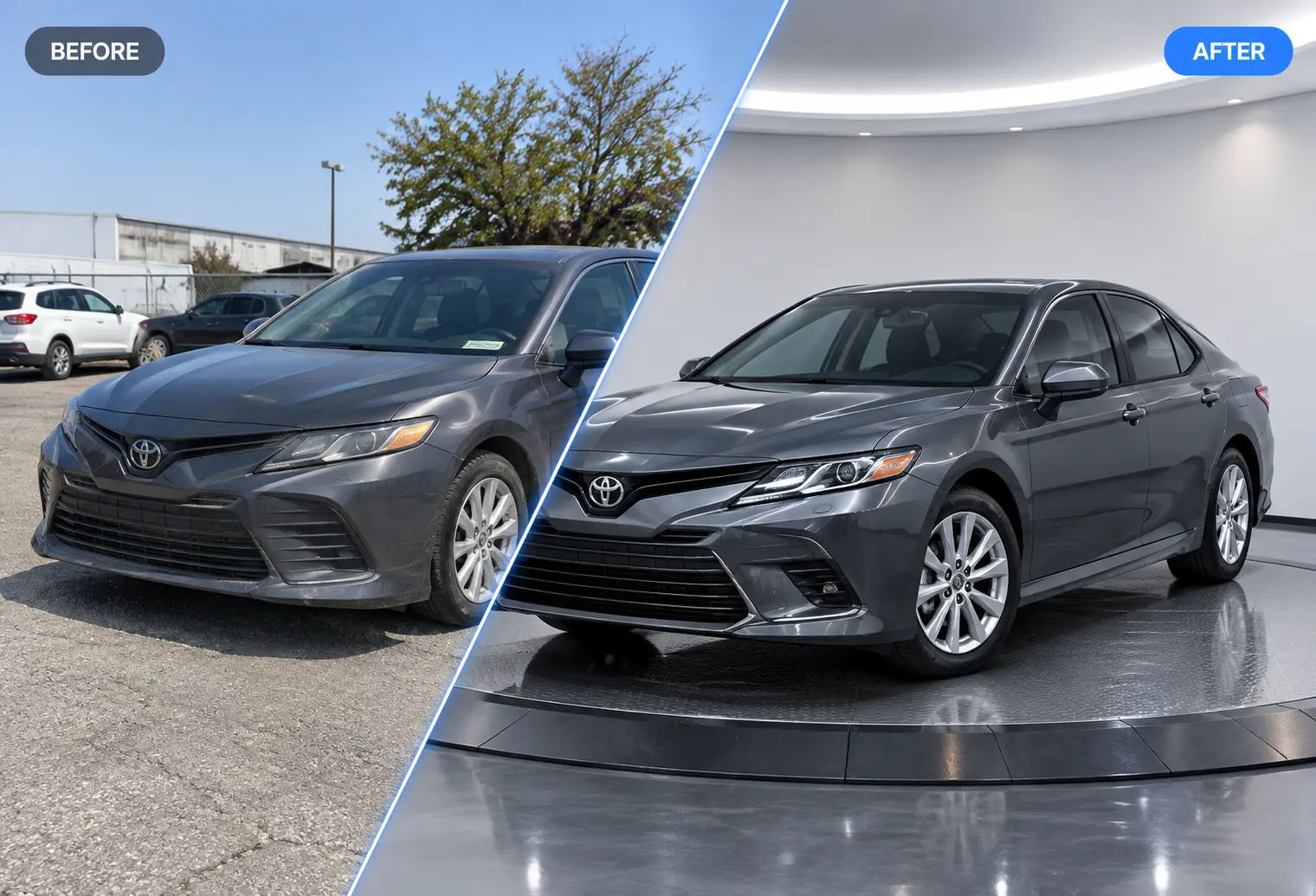
Drivee AI vs CarCutter: All-in-One Platform vs. Specialized Solution
Car Background AI is a good, simple tool that does one thing: it replaces backgrounds on photos you already have. It is also the only imaging vendor we found that publishes its prices, which is genuinely to its credit.
| Drivee AI | Car Cutter | |
|---|---|---|
| AI background removal | Yes | Yes |
| 360° spins | Yes — phone-based capture, no extra equipment | Yes — 4-photo method for exterior; interior needs a 360 camera + tripod |
| AI video tours | Yes — dedicated AI video tours with automated voiceover | No |
| Clickable feature hotspots | Yes | Yes |
| Guided capture from a phone | Yes — 5–10 minute walkaround, no studio or equipment needed | Yes — 4 standard shots, step-by-step guidance, no training needed |
| Publishes to your listings via DMS sync | Yes | Yes |
| Conversational AI and advertising in the same platform | Yes — AI Sales Agent (voice/chat) plus AI Marketing/Automated Advertising, one platform | No — platform is limited to vehicle photography and merchandising |
Bonus: AI for the service drive
Service is an under-served part of dealership AI relative to its profit. The tools built for it are mostly voice-led: Numa (fixed operations and CSI, now expanding into sales after acquiring Ficus in April 2026), STELLA Automotive AI (reception, service and outbound calling), Toma (service advisor call automation), Impel Service AI (lifecycle outreach, recalls and win-back, reporting 95+ additional completed repair orders per rooftop), and Drivee AI-powered service appointment booking, follow-ups, and customer engagement as part of its broader dealership AI platform.
Given that 80% of new-car buyers say they would service where they bought but only a quarter leave with an appointment booked, an AI that books the first service visit during the sale is not a small feature.
How these AI tools work together
Dealers often ask whether these tools overlap. Some do. But in a working stack, each one hands off to the next:
1. A shopper calls, texts or messages your dealership — often after hours.
2. Conversational or voice AI answers within seconds, answers real questions using live inventory, and books an appointment.
3. The CRM or CDP records everything and scores the customer against your database.
4. Follow-up AI keeps the conversation alive for weeks if the customer is not ready.
5. Marketing AI keeps the right vehicles in front of them, and merchandising AI makes those listings worth clicking.
6. A human closes the deal — with full context on what the customer already asked and saw.
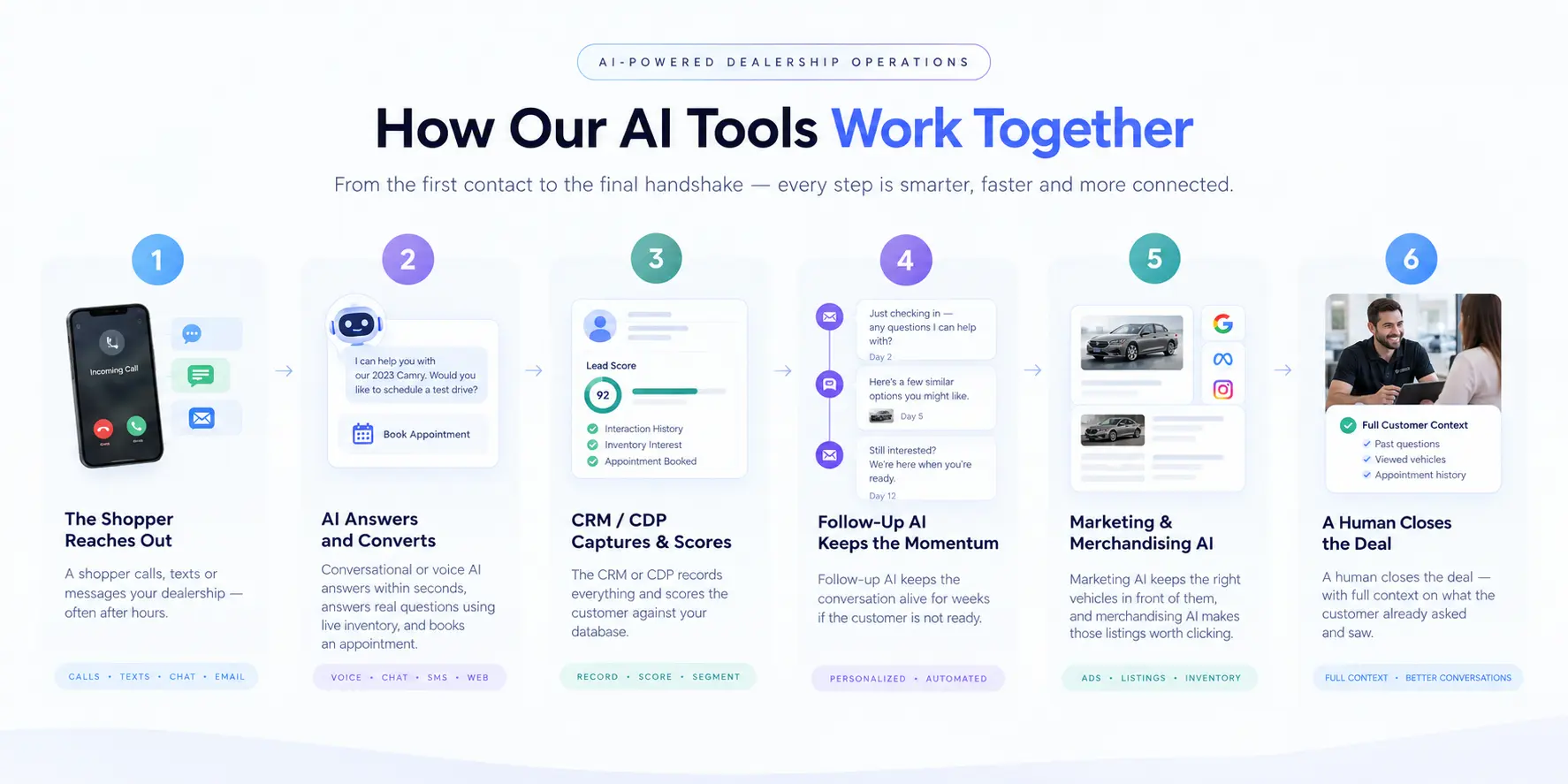
The practical lesson is that the handoffs matter more than the features. A tool that answers brilliantly but writes nothing back to your CRM creates a second, invisible pipeline that nobody works.
A starter stack, by dealership size
You do not need ten tools. Here is what a sensible first stack looks like at three sizes.
| Dealership | Start with | Add next | Leave for later |
|---|---|---|---|
| Independent or single rooftop | One conversational AI that covers phone and text, plus AI photography for your listings | Automated advertising so listings stay live | CRM replacement, CDP, enterprise marketing platforms |
| Multi-rooftop group (2–10 stores) | AI voice for the phones, group-wide, plus AI follow-up connected to your existing CRM | AI-powered CRM or CDP, lead scoring, merchandising at scale | Custom builds and anything requiring in-house data engineering |
| Large group or OEM programme | CDP and agentic CRM foundation, with AI voice and messaging on top | Inventory and VIN-level advertising intelligence, service AI across all stores | Point tools that cannot report across rooftops |
The pattern behind all three: fix the answering problem first, because it needs no data project and shows up in appointments within weeks. Data foundations pay off more, but they pay off later.
How to choose the right AI tool for your dealership
If you are missing calls
Try an AI voice agent before anything else. Ask for its answer rate, how it routes to a person, and whether it books directly into your scheduler. Then check your own missed-call report 30 days later.
If leads go cold
Buy conversational AI with a long follow-up window, and make sure it writes every message back to your CRM. Ask how long it keeps working a lead and what triggers a handoff to a salesperson.
If your service drive is the constraint
Look at service-led tools rather than sales-led ones. Ask specifically about recall handling, status updates, and booking the first service appointment at the point of sale.
If your listings are not getting clicks
Start with imaging and merchandising, not conversation. Nothing you do at the bottom of the funnel fixes listings nobody clicks.
If you already have a CRM you like
Do not replace it. Buy an AI layer that integrates with it, and confirm the integration is real by asking to see data write back into your CRM during the demo.
If you sell used cars only, or run a small independent lot
Prioritise imaging and speed of response over platform depth. Your inventory changes constantly, so favour tools that publish listings automatically and answer inventory questions from a live feed rather than a static database.
What to test during an AI vendor demo
Vendor demos are rehearsed. These eight requests are not, and they expose almost everything that matters:
1. Ask it a question about a specific vehicle in your live inventory, including a trim detail.
2. Send it a vague message — “is this still available?” — with no vehicle named, and watch how it recovers.
3. Send it an angry or confusing message and see when it escalates to a person.
4. Ask for a task it cannot do, and check that it says so instead of inventing an answer.
5. Book an appointment and then check it actually appeared in your scheduler and your CRM.
6. Reply “STOP” and confirm the opt-out is honored everywhere, not just in that one channel.
7. Ask it a question in Spanish, or whichever second language your market uses.
8. Ask the vendor for a named dealership reference of your size and brand, and actually call them.
Common mistakes dealerships make with AI
- Buying a tool before naming the problem. “We need AI” is not a business case. “We miss 40% of service calls after 5pm” is.
- Automating one department and calling it done. A sales AI that cannot see service history creates a disjointed customer experience.
- Not measuring. One in three dealers using AI cannot say what it did, according to Cox. Baseline your numbers before go-live, not after.
- No human escape hatch. Every AI needs a fast, obvious route to a person — for customer experience and for compliance.
- Skipping staff training. If your team does not trust the AI, they will work around it and you will pay for it twice.
How to measure whether it is working
Pick your baseline before you switch anything on. Then track a short list:
| Metric | What it tells you |
|---|---|
| Answer rate and missed calls | Whether the phone leak is closing |
| Speed to first response | Whether you beat the 15-minute benchmark |
| Appointments set and show rate | Whether conversations become traffic |
| Containment rate | Share of conversations the AI finished without a person |
| Cost per appointment | Whether AI beats your current cost of coverage |
| VDP engagement and click-through | Whether merchandising AI is earning attention |
| Repair orders and service retention | Whether service AI is protecting lifetime value |
A simple ROI calculation
Size the leak, estimate recovery, compare to cost. If you miss 200 sales calls a month, two-thirds never call back, and you close 1 in 10 of the ones you do reach, then recovering even a quarter of those missed calls is roughly five extra sold units a year per hundred missed calls — before you count service. Run that math with your own numbers and your own gross, and compare it to the annual subscription. If the tool cannot beat one BDC salary, do not buy it.