

Artificial intelligence (AI) now touches almost every part of the automotive industry. On the road, it powers driver-assistance features and self-driving systems that make cars safer. In factories, it drives predictive maintenance, robotics, and quality control that make manufacturing faster and more precise. In vehicle design, it runs the simulations that make new models lighter, safer, and quicker to build. And at car dealerships, AI runs the chatbots, voice agents, and marketing tools that help buyers find the right car and help dealers sell more of them.
That is the short answer. Below, we break down exactly how AI is reshaping every stage of the automotive journey, from the factory floor to the finance office.
$4.3B → $14.9B
Automotive AI market, 2024 to 2030
23%+
Compound annual growth rate
50%+
U.S. dealerships already using AI
Audio version
The Role of AI in the Automotive Industry
This shift is happening fast. The global automotive AI market is projected to grow from about $4.3 billion in 2024 to nearly $14.9 billion by 2030, according to Grand View Research — a compound annual growth rate above 23%. That growth is not just about self-driving cars, either. Cox Automotive data shows that more than half of U.S. dealerships already use AI in some form, most often through website chatbots and voice agents. This guide walks through every major use case, the real companies putting it to work, and where the technology is headed next.

What Is the Role of AI in the Automotive Industry?
The role of AI in automotive is much broader than self-driving cars. AI analyzes data, recognizes patterns, predicts outcomes, automates repetitive decisions, and personalizes experiences. These capabilities are applied across the entire automotive value chain.
- Vehicle safety and ADAS
- Autonomous driving and perception
- Manufacturing and quality control
- Predictive maintenance
- Vehicle design and engineering
- EV battery management
- Connected cars and V2X
- Cybersecurity
- Dealership sales and customer engagement
- Inventory, pricing and automotive marketing
How AI Is Used in the Automotive Industry
AI plays a role in nearly every corner of the automotive world today. It is not one single technology — it is dozens of tools working together, including machine learning, computer vision, natural language processing, and robotics. Together, they touch four major areas: how cars are built, how they are designed, how they drive, and how they are sold. Let’s look at each one.
AI in Automotive Manufacturing

Predictive Maintenance and Smarter Production
AI has become essential in modern automotive manufacturing. Predictive maintenance is a good example. Sensors and machine learning models track equipment wear and flag problems before they cause a breakdown. McKinsey research shows this approach can cut equipment downtime by up to 50% and lower maintenance costs by 10% to 40%, compared with reactive repairs.
AI-Powered Automation and Quality Control
On the assembly line, AI-powered robots take over repetitive tasks with speed and precision. This improves both efficiency and worker safety. At the same time, computer vision systems inspect parts in real time, catching defects that a human inspector might miss.
Supply Chain Management
AI also strengthens the supply chain behind the scenes. It forecasts demand, manages inventory levels, and reroutes shipments automatically when a delay pops up. Together, these tools help automakers build vehicles faster, with fewer errors and fewer interruptions.
AI in Vehicle Design and Engineering
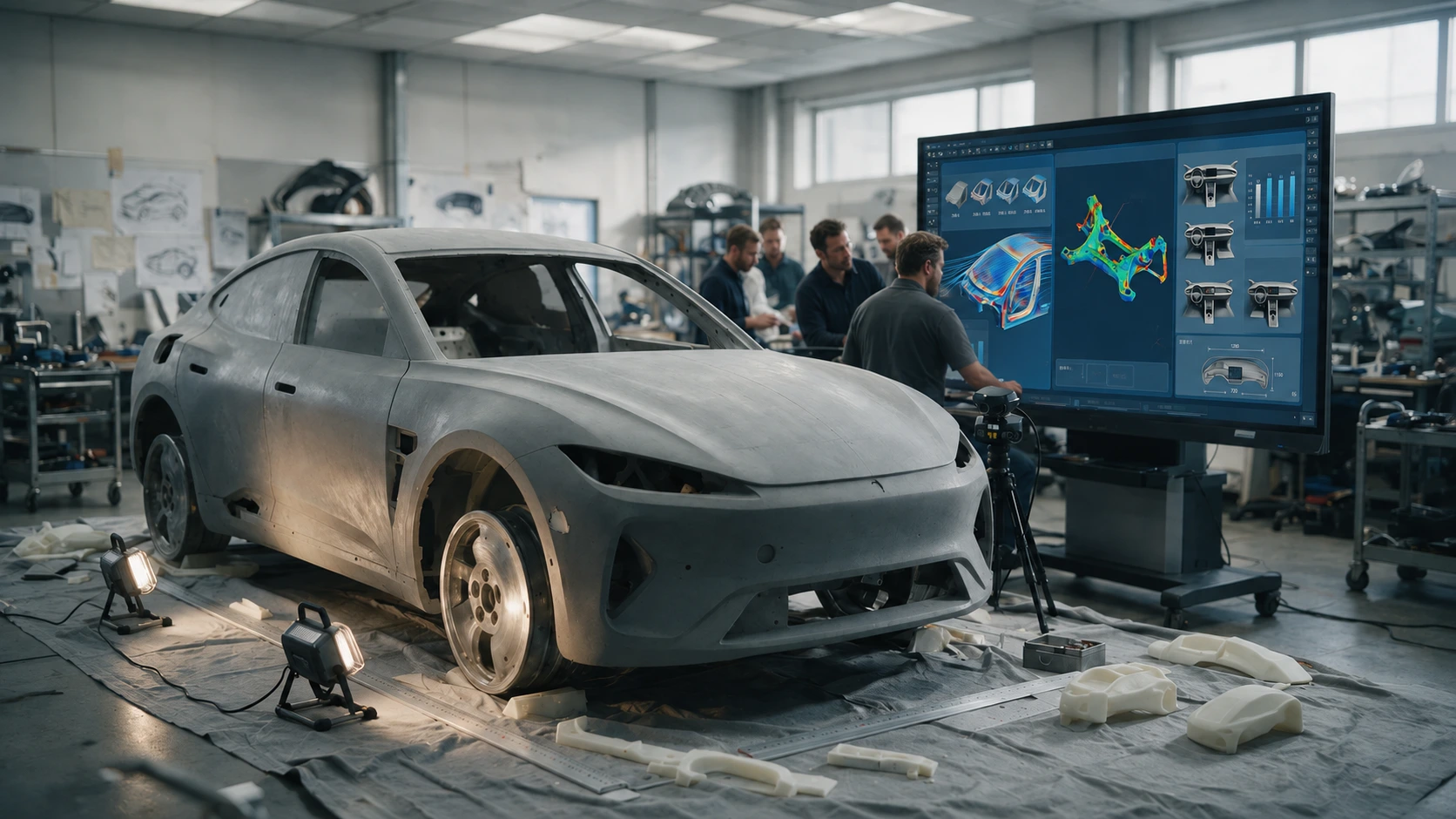
AI can accelerate parts of vehicle development by allowing engineers to test more possibilities digitally. Generative design, simulation, digital twins and machine learning help teams evaluate weight, strength, aerodynamics, safety and manufacturability before building physical prototypes.
- Generative design explores many component configurations.
- Simulation reduces dependence on early physical prototypes.
- Digital twins represent vehicles, components or production systems in software.
- AI-assisted engineering helps prioritize promising designs and experiments.
- Computer vision can analyze test footage and identify patterns.
AI in Autonomous Driving & Advanced Safety Features (ADAS)

Self-driving technology is one of the most visible uses of AI in the automotive industry. Advanced Driver-Assistance Systems (ADAS) already use AI to support features like lane-keeping, adaptive cruise control, and automatic emergency braking. Computer vision helps a vehicle recognize pedestrians, cyclists, and road signs in real time.
This rapid progression toward autonomy was highlighted by Fortune.com:
Elon Musk is banking on exponential growth of self-driving cars and humanoid robots to make Tesla the most valuable company in the world.
Driver-monitoring systems add another layer of safety. AI-powered cameras can detect drowsiness or distraction and alert the driver before a mistake turns into an accident. As these systems keep improving, they are not just making everyday driving safer — they are laying the groundwork for fully autonomous vehicles.
ADAS should not be confused with fully autonomous driving. NHTSA states that Level 1 and Level 2 are driver-assistance technologies in which the human remains responsible for driving. NHTSA also states that Level 3–5 automated-driving technologies are not available on today’s vehicles for consumer purchase in the United States.
SAE Driving Automation Levels
Note: Level 4 autonomous vehicles currently operate commercially in limited regions. Waymo vehicles provide fully autonomous rides through Uber in select U.S. cities. However, this differs from purchasing fully autonomous Level 4 or 5 vehicles for personal use.
AI in Connected Cars and V2X
Connected vehicles generate data about vehicle status, location, road conditions, traffic and driver interactions. AI can turn that data into useful predictions and automated services.
- Predictive service alerts
- Personalized navigation
- Traffic prediction
- Fleet monitoring
- Remote diagnostics
- Vehicle-to-vehicle and vehicle-to-infrastructure coordination
V2X extends vehicle intelligence beyond the car itself. Vehicles can exchange information with other vehicles, roadside infrastructure and cloud systems. The long-term goal is safer and more coordinated mobility.
AI in Electric Vehicles and Battery Management

Battery performance affects EV range, charging time, safety, cost and vehicle life. AI and machine learning can support state-of-charge estimation, battery-health prediction, range estimation, charging optimization, thermal management and battery research.
Stanford researchers reported a machine-learning approach that reduced certain battery testing times by 98%, addressing a major bottleneck in battery development.
- State-of-charge estimation
- State-of-health estimation
- Range prediction
- Charging optimization
- Battery degradation prediction
- AI-assisted battery research
AI in Automotive Cybersecurity

As cars get more connected, the risk of cyber threats rises with them. AI plays a growing role in detecting anomalies in vehicle data streams, preventing fraud, and securing car systems. Callisto’s AI-powered Vehicle Security Operations Center, for example, continuously monitors logs to spot potential threats and reduce false alarms, distinguishing unusual door activity from normal use.
Smart Eye takes a different angle, using computer vision and deep learning to monitor driver behavior and detect distraction or drowsiness, on hardware designed to preserve privacy by not storing unnecessary video.
Regulation is catching up too. Standards like ISO/SAE 21434 and UN Regulation No. 155 now require automakers selling in many markets to build and maintain a formal cybersecurity management system across a vehicle’s entire lifecycle. The NHTSA also publishes cybersecurity best practices for modern vehicles in the U.S.
AI in Car Dealerships and Automotive Retail

AI is changing how dealerships attract shoppers, respond to leads, manage inventory, communicate with customers and measure performance. This is one of the most practical areas of automotive AI because dealership workflows contain many repetitive, data-driven tasks.
AI lead response and qualification
AI can respond to website, SMS, email, marketplace and social media leads instantly. It can answer basic questions, identify vehicle interest, collect contact information, qualify the shopper and move the conversation toward an appointment.
Cox Automotive’s current research emphasizes that inventory quality, data connectivity and workflow integration strongly influence AI performance in dealerships.
“Inventory quality, data connectivity and workflow integration strongly influence AI performance in dealerships.”
50%+
of U.S. dealerships already use AI
Voice AI for car dealerships
Chat is only half the picture. A growing number of dealerships now use AI voice agents to handle phone calls too — both inbound and outbound. A good voice AI can answer an incoming call in seconds, discuss inventory and pricing in a natural, human-like way, and book a test drive directly into the dealership’s calendar. It can also place outbound calls: following up on a lead, confirming an appointment, or re-engaging a shopper who went cold weeks ago.
- 24/7 inbound call answering
- Natural multi-turn conversations
- Vehicle-specific answers from current inventory
- Lead qualification
- Test-drive and appointment scheduling
- Appointment reminders
- Outbound lead re-engagement
- Human escalation
Drivee’s AI Sales Agent combines conversational AI, voice AI, lead qualification, appointment scheduling, follow-up and dealership inventory information + CRM/DMS integration.
AI inventory management and pricing
AI can analyze sales history, vehicle attributes, pricing, market conditions and customer behavior to support inventory and pricing decisions. Cox Automotive reported that its AI capabilities can identify shoppers who are up to eight times more likely to buy using behavioral data and predictive insights.
AI-powered 360° car photography
AI is transforming vehicle photography by replacing expensive studios, specialized equipment, and lengthy production processes. Instead of sending vehicles to a studio and waiting days for a finished 3D model, dealerships can now capture a vehicle’s 360° view directly on their lot using just a smartphone. AI processes the footage, creates an interactive 3D experience, and reduces the cost and time needed to showcase vehicles online.
Drivee’s 360° car photography app helps dealerships create interactive 3D vehicle models from their lot in under 20 minutes.
AI marketing and inventory publishing
AI can automate repetitive inventory marketing tasks. It can help generate listings, adapt copy for different channels, publish vehicles and keep information synchronized when prices or availability change.
Drivee Automated Advertising connects inventory with multi-platform publishing and automated updates.

Real-World Applications and Examples of AI in Automotive
Some of the most advanced uses of AI in the automotive industry are already on the road today. Tesla builds AI into its Autopilot and Full Self-Driving systems, using computer vision and deep learning to process road data in real time.
Waymo, a leader in autonomous driving, relies on AI-powered sensors and mapping to run driverless taxis at real commercial scale. As of early 2026, Waymo had expanded fully driverless robotaxi service to eleven U.S. cities, saying the move “deepens our commitment in the states of Texas and Florida.” Reports put its fleet at roughly 3,000 vehicles delivering around 500,000 paid rides a week, with a stated goal of reaching one million weekly rides by the end of 2026.
Tesla’s robotaxi program, meanwhile, has expanded more cautiously. Reporting from early 2026 shows Tesla operating in far fewer cities, with many vehicles still running with a safety monitor on board. It’s a useful reminder that ambitious announcements and real-world, driverless-at-scale deployment are two very different milestones.
BMW applies AI beyond driver assistance, using it in its factories too, where intelligent robots and predictive maintenance keep production running smoothly. Toyota uses AI in both vehicle design and safety systems, combining machine learning with advanced simulations to improve performance. Together, these companies show how AI has moved from concept to everyday reality across driving, manufacturing, and customer experience.

AI in Dealerships: Inventory Management & Customer Experience
For inventory management, AI systems provide a centralized, real-time dashboard covering every vehicle: available, sold, financeable, or trending with buyers. AI algorithms analyze historical sales data, customer preferences, and seasonal trends to predict which vehicles and parts will be in high demand.
For example, Cox Automotive reports that AI-driven inventory tools can cut excess stock by up to 30%, freeing up capital and speeding up sales. Some dealerships also use AI-powered pricing tools that pull in millions of data points from auctions, competitor listings, and consumer behavior to suggest fair, competitive prices automatically.
Benefits of AI in the Automotive Industry
Where AI is paying off
- Safer roads — ADAS and driver-monitoring systems reduce human error, the leading cause of crashes.
- Faster, cheaper manufacturing — predictive maintenance and robotics cut downtime and production costs.
- Higher build quality — computer vision catches defects a human inspector might miss.
- Longer-lasting EV batteries — AI-optimized battery management extends range and battery life.
- Faster car buying — 24/7 AI chat and voice agents answer buyers instantly instead of making them wait.
- More personalized shopping — recommendation engines match buyers to cars they actually want.
- Smarter inventory decisions — AI predicts demand and prices vehicles more competitively.
- Stronger security — AI detects cyber threats and fraud before they cause harm.
Challenges and Disadvantages of AI in the Automotive Industry
Where AI still falls short
- High cost — developing and maintaining AI systems requires significant investment and large amounts of clean data.
- Trust gaps — Cox Automotive research found that 74% of dealers still worry about AI accuracy, and 66% want better training on where AI realistically fits into daily operations.
- Data privacy concerns — connected cars collect large volumes of driver and location data, raising legitimate privacy questions.
- Job displacement worries — heavier automation in factories and dealerships raises concerns about certain roles shrinking over time.
- Cybersecurity risk — more connected systems mean a larger attack surface for bad actors to target.
- Regulatory uncertainty — rules around autonomous vehicles and AI-driven decisions are still evolving in many regions.
The Future of AI in the Automotive Industry (2030 and Beyond)

By 2030, AI is set to reshape what owning a car means and what people expect from mobility. McKinsey & Company projects that shared mobility and connectivity services could account for up to 25% of total automotive industry revenue by 2030, as value shifts away from simply selling a vehicle and toward selling time, access, and ongoing service.
“Shared mobility and connectivity services could account for up to 25% of total automotive industry revenue by 2030.”
25%
of industry revenue by 2030
Robotaxis are moving from pilot projects to real infrastructure. Waymo has stated a goal of reaching one million weekly rides by the end of 2026 and has outlined plans to enter twenty or more cities globally in the years ahead. Level 2 driver-assistance, as we covered earlier, is expected to become standard equipment on the majority of new vehicles sold worldwide well before the decade is out.
EV subscription services — bundling charging, software updates, and battery maintenance into one monthly plan — are also expected to grow quickly as automakers look for recurring revenue beyond the initial sale.
For customers, all of this points toward a more personal, seamless driving experience. Cars will increasingly act like mobile devices: learning driver preferences, suggesting routes, and handling routine tasks like parking or scheduling maintenance on their own. Instead of just being vehicles, cars are becoming intelligent companions connected to homes, workplaces, and city infrastructure — a shift from cars as products to cars as part of a much larger mobility ecosystem.
Final Thoughts
AI is no longer a future bet for the automotive industry — it is already reshaping how cars are built, driven, and sold. The dealerships and manufacturers moving early are the ones capturing the biggest gains in speed, safety, and customer trust. Whether you are evaluating AI for your factory floor or your showroom, the tools covered in this guide are a solid place to start.